BOROUX Water Filter Review: The Best Berkey Alternative?
When Berkey faced EPA scrutiny in 2023 and retailers quietly pulled products, thousands of preppers and water-conscious homeowners started asking the same question: what’s the replacement? BOROUX emerged as a serious contender, and now it’s everywhere from YouTube reviews to homesteading forums. But is it actually as good as the mythology suggests, or does it just benefit from the Berkey vacuum?
Here’s what you need to know: BOROUX makes gravity-fed stainless steel water filters that look very similar to Berkey systems but cost less and are manufactured in the US. They claim NSF certification, superior filtering capacity, and lower replacement costs. But real users report inconsistent water flow, occasional leaks, and filtering performance claims that sound better on the website than in practice. The system isn’t bad. It’s just not magical, and that’s important context before you drop $300+ on one.
This review cuts through the affiliate hype and reseller enthusiasm to tell you exactly who should buy BOROUX and who should look elsewhere.
What Is BOROUX?
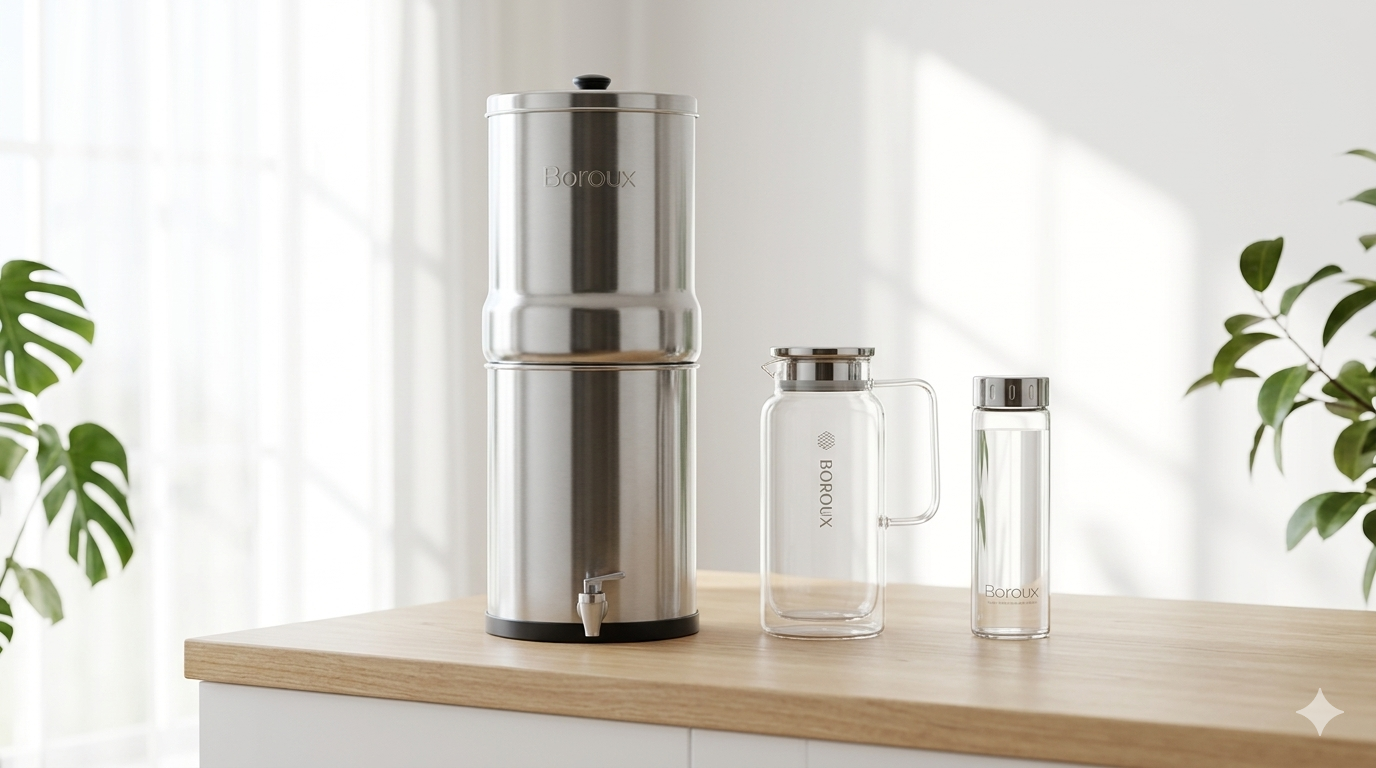
BOROUX is a gravity-fed water filtration system made from polished stainless steel. Water flows by gravity through two or four filter elements (depending on the model), and the company claims these filters remove bacteria, viruses, heavy metals, and chemical contaminants. The base model runs around $300, and larger systems or additional filters push the total closer to $500.
The company positions itself directly as a Berkey alternative. Their filters are proprietary but follow the same gravity-fed design philosophy. BOROUX advertises made-in-America production, NSF/ANSI certification claims (though the certification scope is narrower than often implied), and a lifetime warranty on the stainless steel housing. For most users, the system sits on a kitchen counter and quietly processes water over several hours.
Who Is This Actually For?
BOROUX is ideal for someone who wants a no-electricity, no-subscription water filter for their kitchen, is comfortable waiting 4-6 hours for filtered water, doesn’t mind manual maintenance, and has the budget for a $300-400 upfront cost. Preppers, off-grid homeowners, people skeptical of municipal water, and families wanting an alternative to bottled water all make sense here.
Skip BOROUX if you need fast filtered water (point-of-use filters are way quicker), rent and can’t commit to counter space, have low water volume needs, or are price-sensitive below $250. Also skip it if you’ve had past issues with water leaks in your home, because gravity-fed systems do occasionally develop drips around the lower spigot.
What Real Users Love About It
Users consistently praise the build quality and aesthetics. The stainless steel housing feels premium and looks intentional on a countertop, not like a janky science experiment. Several Reddit threads in r/BuyItForLife and r/preppers mention owners keeping the same BOROUX system for 5+ years without major issues.
The filtering speed is better than expected by most buyers. While waiting 4-6 hours for a full lower chamber is slower than some competing systems, the flow rate doesn’t slow down catastrophically as the filter ages, unlike some alternatives. Users also appreciate the modular filter approach, allowing you to upgrade to four filters if you want faster throughput later.
Cost of ownership matters too. Replacement BOROUX filter elements run $40-60 per pair, which is cheaper than most third-party Berkey clone filters. Owners report a realistic replacement schedule of every 6-12 months depending on water volume, with clearer manufacturer guidance than Berkey ever provided.
What to Know Before You Buy
First, water flow is slower than marketing implies. In practice, filling a two-liter pitcher takes 2-3 hours, and the upper-to-lower chamber transition takes 4-6 hours for a full cycle. This is fine if you refill the night before, frustrating if you’re thirsty right now.
Second, the filtering claims need context. BOROUX advertises removing 99.9% of certain contaminants, but “remove” can mean different things. The actual NSF certification covers specific contaminants (chlorine, taste/odor, sediment), not viruses or heavy metals to the degree the marketing suggests. If you’re testing water quality in a lab, don’t expect BOROUX to deliver what a full-house system would. It’s a secondary filter, not a total solution.
Third, some units develop slow leaks around the lower spigot over time. This isn’t universal, but enough users report it that you should expect to tighten or replace the spigot gasket as part of regular maintenance. BOROUX’s customer service generally handles this well, but it’s extra work you might not anticipate going in.
Finally, the filter elements are proprietary. You can’t buy cheap third-party replacements like you can with some Berkey clones. This locks you into BOROUX’s pricing, which is reasonable but not flexible.
How It Compares to Berkey, ProOne, and Alexapure
Against Berkey, BOROUX wins on availability (Berkey is hard to find now), price (cheaper), and US manufacturing. Berkey flows slightly faster with third-party clone filters, but both systems filter at roughly the same speed with stock filters. Berkey has more third-party filter options and longer brand history. If Berkey were available at normal prices, it would still be the safer established choice. But BOROUX is a reasonable substitute for someone who can’t get Berkey.
ProOne makes gravity filters with activated carbon and specialty media. ProOne filters are slower than BOROUX and more expensive upfront, but some users report better taste/odor removal. ProOne markets heavily to health-conscious buyers at premium pricing. BOROUX is faster and cheaper, but doesn’t claim the same mineral retention benefits ProOne advertises.
Alexapure is made by the same parent company as BOROUX and is essentially the same system with slightly different marketing. They’re directly comparable, so pick based on which brand story resonates with you, not on performance differences.
Is It Worth the Price?
Yes, if you need gravity-fed filtration and can’t access Berkey. At $300-400, you’re paying for US manufacturing, reasonable build quality, and a decade-plus lifespan. The replacement filter costs are sustainable, and you’re not locked into a subscription model.
No, if you’re buying BOROUX as a total water solution expecting lab-grade quality, or if you have budget for a whole-house system instead. BOROUX is a partial solution that makes sense for specific situations, not a universal answer to all water concerns.
Our Verdict
BOROUX is a solid, honest middle-ground water filter for people who need gravity-fed simplicity and don’t have Berkey access. It’s not revolutionary, doesn’t filter better than physics allows, and requires real maintenance. But it works, looks good, and costs less than the hype-driven alternatives. Recommended for preppers, off-grid homeowners, and skeptical tap water avoiders with realistic expectations about what a countertop gravity filter can and can’t do.
Frequently Asked Questions
Does BOROUX actually remove viruses and bacteria?
The system can filter certain bacteria and protozoa with proper filter elements, but virus removal isn’t guaranteed across all model variations. Don’t rely on BOROUX alone for water from questionable sources like untreated lakes. If virus removal is critical, pair it with boiling or get the optional specialty filters.
How often do you need to replace the filters?
BOROUX recommends replacing filters every 6-12 months based on water volume and quality. Most users report actual replacement timing closer to 12-18 months with household tap water. If you’re filtering questionable water or have high volume, plan on 6-month cycles. Budget roughly $50-60 per replacement pair.
Does it actually fit under a cabinet?
No true under-sink installation is possible since gravity filtration requires the upper chamber to be higher than the lower. It’s compact enough for most kitchen corners, but plan on about 8 inches by 8 inches of countertop footprint. If counter space is tight, it’s a real problem.
What’s the difference between the two-filter and four-filter models?
Two filters handle normal household volume. Four filters double the filtering capacity and speed, useful for families or high-volume users. Four-filter systems cost about $100 more and take up slightly more space. If you’re impatient with water flow, the four-filter upgrade is worth considering.
Can you use third-party filters in BOROUX?
Not officially, and it’ll void the warranty. The filters are proprietary, so you’re buying into BOROUX’s replacement ecosystem. This keeps pricing controlled but removes flexibility compared to systems with open filter standards.
Is BOROUX better than just using a cheap pitcher filter?
Yes, measurably. BOROUX filters remove more contaminants and have longer lifespan than Brita or similar pitcher filters. Pitcher filters work fine for taste and odor improvement, but BOROUX handles sediment and broader chemical removal. If you’re already buying bottled water, BOROUX is worth the upfront cost over time.